Evaluating Stressors and Their Effects
The first step in helping clients manage stressors so that they serve as challenges and motivating factors in their lives but do not lead to disease processes is to thoroughly evaluate past and present stressors and the stressors’ effects on clients’ bodies. Table 13-1 shows the Holmes and Rahe Social Readjustment Rating Scale. You may want to take a few moments to mark down your score for each life event according to whether or not the item applies to you in the past twelve months. For instance, if you have become divorced in the past twelve months, in the second colum of the table you would write the number 73 on the second blank from the top. When you are finished, total the numbers you have written in and this will be your Life Change Score for the past twelve months. If your score is over 300, you have approximately a 90% chance of a very serious health change in the next two years. A score of 150 to 299 indicates approximately a 50% chance of a serious illness, and a score of less than 150 Life Change Units is correlated with a 30% chance of serious illness.
Table 13-1. The Holmes and Rahe Social Readjustment Rating Scale
| Item Value | Your Score | Life Event |
|---|---|---|
| Divorce | ||
| Marital separation | ||
| Jail term | ||
| Death of close family member | ||
| Personal injury or illness | ||
| Marriage | ||
| Fired from job | ||
| Death of spouse | ||
| Death of close friend | ||
| Marital reconciliation | ||
| Retirement | ||
| Change in health of family member | ||
| Pregnancy | ||
| Sex difficulties | ||
| Gain new family member | ||
| Business readjustment | ||
| Change in financial state | ||
| Change to different line of work | ||
| Change in number of arguments with spouse | ||
| Mortgage over $10,000 | ||
| Foreclosure of mortgage or loan | ||
| Change in responsibilities at work | ||
| Son or daughter leaving home | ||
| Trouble with in-laws | ||
| Outstanding personal achievement | ||
| Spouse begins or stops work | ||
| Begin or end school | ||
| Revision of personal habits | ||
| Trouble with boss | ||
| Change in work hours or conditions | ||
| Change in residence | ||
| Change in schools | ||
| Change in recreation | ||
| Change in church activities | ||
| Change in social activities | ||
| Mortgage or loan less than $10,000 | ||
| Change in sleeping habits | ||
| Change in number of family get-togethers | ||
| Change in eating habits | ||
| Vacation | ||
| Christmas | ||
| Minor violations of the law | ||
| Total Score (for 12 months) |
Figure 13-2 illustrates a rather casual but graphic method of determining your present patterns of exchanging energy with your environment as a way of measuring possible depletion of energy as a stress factor. In using this tool, begin by drawing a figure in the middle of a sheet of paper which symbolizes yourself. Add to that picture symbols that have meaning to you as representing people or activities that play an important part in your present life situation. Label each symbol as you draw it. Then draw arrows to and from yourself and each of the other people or activities in your picture. Let each arrow stand for one unit of energy. In some instances the energy exchange between you and another person or an activity may be equal; that is, you feel that you give as much energy as you get. In other instances, you may give two units of energy and receive only one in return and would indicate that by two arrows going from you and one arrow coming back. When you are finished drawing in all the arrows, count the total number that are going out from you and the total that are coming toward you. Compare these two totals to see what the net result is in terms of energy exchange. If there are what seem to you to be a significantly higher number of arrows going out from you than toward you, you may want to consider the idea that you are stressing yourself by depleting your own life energy. A close look at this energy-exchange picture you have drawn may give you some hints on how to avoid such depletion of energy in the future.
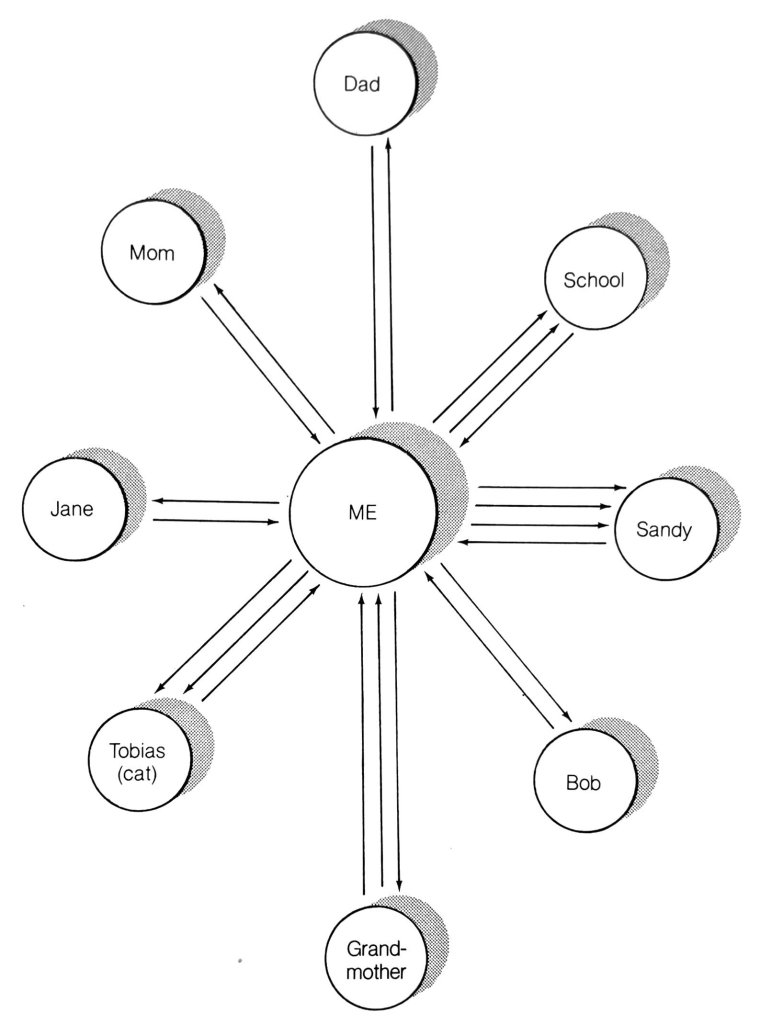
(Stress Management Center of Metropolitan Washington,
621 Maryland Avenue, N.E., Washington, D.C. 20002.
Used with permission.)
A third way to evaluate stressors and their effects is to help clients (and one’s self, of course) be aware of thoughts, attitudes, values, and beliefs that are mediating conditioning factors in their stress responses. For instance, let us say that a person holds a belief, which is either in or out of his or her awareness, to the effect that strangers are likely to be dangerous. If the person holding this belief is driving alongside another car and the other car eases toward his or her car, that person may react with fury and an intense physiologic stress response and may even lose control over his or her own vehicle. Someone who believes that strangers are “regular” people would be likely to assume that the other driver is being careless but not intentionally harmful and would stay calm and blow the horn as a brief signal to warn the other driver. Trying to be aware of subtle thoughts, often of a disparaging nature to one’s self, can be difficult. Beginning by recalling a stress response and then tracing back to what one was thinking, even in a subtle form, just prior to the stress reaction may be a helpful method to use.
Another method of evaluating your level of distress is to note signs of distress in your body. For instance, let yourself reexperience some highly stressful event for approximately one minute and notice during that time which areas of your body become most tense, which areas become cool; or which areas perspire or become overly dry. Noticing these details of your body’s probably typical reaction to a stressful event will help you be aware of your own patterned responses your to stressors and will give you some ideas about which parts of body to maintain a closer awareness of in order to keep these areas relaxed rather than tensed.
Another simple indicator of distress in the body is the temperature of one’s hands. Warm, dry hands are a sign of relaxation and parasympathetic nervous system activity. Cool or cold hands, presuming that one does not have a circulatory disease and does not reside near the North Pole, indicate a state of distress in which the sympathetic nervous system is active. Preparing the body for “fight or flight” activity demands that the blood supply be channeled away from the periphery of the body.